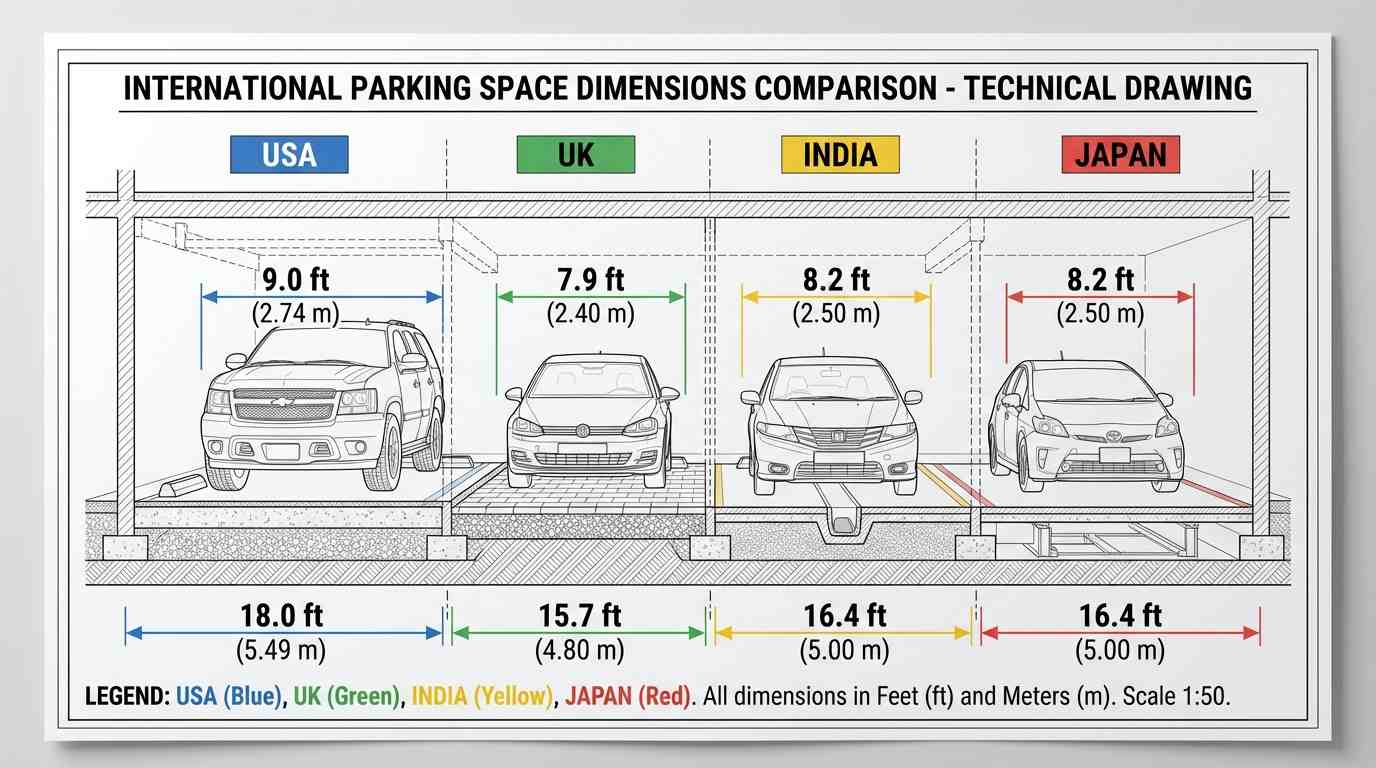
Parking space dimensions vary significantly across countries, reflecting differences in vehicle sizes, urban planning philosophies, and local regulations. Understanding the standard car parking size in feet for different regions is essential for property developers, architects, and facility managers to ensure compliance and optimize space utilization. Whether you’re designing a commercial parking lot in the United States or planning residential parking in India, knowing these international standards will help you create functional, code-compliant parking facilities that accommodate diverse vehicle types.
Standard Parking Dimensions USA
Table of Contents
The United States follows relatively generous parking space standards designed to accommodate the country’s traditionally larger vehicles. Standard parking spaces in the USA typically measure 9 feet wide by 18 feet long, though dimensions can range from 8.5 to 9 feet in width and 18 to 24 feet in length depending on the facility type and local ordinances. The minimum required parking space for one car is generally 8 feet 6 inches wide and 18 feet long, providing adequate room for sedan and SUV parking. Interestingly, there are approximately eight parking spaces for every vehicle in the United States, reflecting the country’s car-centric infrastructure.
Parking configurations also affect space requirements, with perpendicular (90-degree) parking typically requiring 20-24 feet of depth plus 24-26 feet of aisle width for two-way traffic. Angled parking at 45 or 60 degrees can reduce space requirements while improving traffic flow in certain applications.
| Parking Type | Width (Feet) | Length (Feet) | Typical Application |
|---|---|---|---|
| Standard Space | 9-10 | 18-20 | General commercial lots |
| Compact Space | 8-8.5 | 16-18 | Small vehicle areas |
| Parallel Space | 8-8.5 | 22-24 | Street parking |
| ADA Accessible | 8 + 5 ft aisle | 18 | Handicap spaces |
| Truck/Oversized | 10-12 | 20-24 | Heavy-duty vehicles |
| 45° Angled | 12-14 | 20-22 | Retail centers |
| 60° Angled | 14-16 | 22-24 | Office complexes |
| 90° Perpendicular | 20-24 | 24-26 | Commercial lots |
UK Parking Standards
The United Kingdom implements stricter parking regulations compared to North America, reflecting the country’s more compact urban environments and smaller average vehicle sizes. The minimum car parking space dimension in the UK is 2.4 meters (7 feet 10 inches) wide by 4.8 meters (15 feet 9 inches) long, according to permitted vehicle specifications. The minimum width requirement stands at 7.9 feet, significantly narrower than American standards, while the minimum length must be at least 16 feet. The distance between parking bays for maneuvering (roadways) is specified at 6 meters to ensure adequate turning radius.
British parking facilities often feature tighter configurations that maximize space efficiency in densely populated areas. These dimensions accommodate the majority of vehicles sold in the UK market, which tend to be smaller than their American counterparts.
| UK Parking Specification | Metric Measurement | Imperial Equivalent |
|---|---|---|
| Minimum Width | 2.4 meters | 7.87 feet |
| Minimum Length | 4.8 meters | 15.75 feet |
| Recommended Width | 2.4 meters | 7.87 feet |
| Recommended Length | 4.8 meters | 15.75 feet |
| Maneuvering Aisle | 6 meters | 19.69 feet |
| Disabled Bay Width | 3.6 meters | 11.81 feet |
| Disabled Bay Length | 4.8 meters | 15.75 feet |
🚗 Parking Space Calculator
Calculate required parking lot dimensions and total spaces for your project
🌍 Location & Standards
📐 Project Requirements
⚙️ Additional Options
📊 Calculation Results
India Parking Dimensions
India’s parking standards are established by the Chennai Metropolitan Development Authority (CMDA) and other regional authorities, with dimensions designed to accommodate the country’s diverse vehicle fleet. According to CMDA policies, a parking area must be at least 2.5 meters (8 feet 2 inches) wide and 5 meters (16 feet 4 inches) long. These standards represent minimum requirements, and many modern facilities implement larger spaces for improved user convenience. Indian parking facilities must consider the prevalence of compact cars, motorcycles, and increasingly popular SUVs when planning space allocation.
Traffic intensity also influences width requirements in India, with low-traffic facilities (serving students or employees) requiring 8 feet 6 inches wide spaces, while moderate to high-traffic facilities (medical centers, retail) should provide 9-foot widths.
| India Parking Category | Width Requirement | Length Requirement | Facility Type |
|---|---|---|---|
| CMDA Standard | 8 ft 2 in (2.5 m) | 16 ft 4 in (5 m) | General parking |
| Low Traffic | 8 ft 6 in | 16 ft 4 in | Employee/student parking |
| Moderate Traffic | 9 ft | 16 ft 4 in | Retail/medical facilities |
| High Traffic | 9 ft | 16 ft 4 in | Commercial centers |
| Two-Wheeler | 2 ft 6 in | 6 ft | Motorcycle parking |
| Luxury/SUV | 9 ft 6 in | 18 ft | Premium vehicle areas |
| Disabled Parking | 12 ft | 18 ft | Accessible spaces |
European Parking Standards
European countries exhibit considerable variation in parking space dimensions, reflecting different national standards and urban planning traditions. In Germany, parking regulations follow the DIN 18040-1 standard, which mandates that accessible parking spaces measure at least 3.5 meters (11.5 feet) wide and 5 meters (16.4 feet) long. France follows the Norme NF P 91-100 standard, requiring parking spaces to be at least 7.2 to 7.5 feet wide to ensure comfortable parking. The Netherlands has implemented smaller parking spaces in some areas to conserve space and reduce urban congestion.
Standard perpendicular parking spaces across Europe typically measure 5 meters long by 2.30 meters wide, though dimensions vary by country and facility type. Switzerland takes parking regulations particularly seriously, having established a Swiss Association in 2016 specifically to inspect and regulate parking space sizes.
| European Country | Standard Width | Standard Length | Special Requirements |
|---|---|---|---|
| Germany (DIN 18040-1) | 11.5 ft (3.5 m) | 16.4 ft (5 m) | Accessible spaces |
| Germany (Standard) | 7.9 ft (2.4 m) | 16.4 ft (5 m) | Regular spaces |
| France (NF P 91-100) | 7.2-7.5 ft (2.2-2.3 m) | 16.4 ft (5 m) | Minimum comfort standard |
| Netherlands | 7.2 ft (2.2 m) | 15.7 ft (4.8 m) | Space-saving design |
| Switzerland | 7.9 ft (2.4 m) | 16.4 ft (5 m) | Regulated by association |
| Spain | 7.5 ft (2.3 m) | 16.4 ft (5 m) | Urban parking |
| Italy | 7.9 ft (2.4 m) | 16.4 ft (5 m) | Standard configuration |
Asian Parking Requirements
Asian countries typically implement parking standards tailored to local vehicle sizes and urban density constraints. In Japan, parking spaces are typically 8.2 feet by 16.4 feet, with a minimum width of 7.5 feet reflecting the country’s compact vehicle preferences. China implements slightly larger parking spaces with a standard size of 8.2 feet by 18 feet to accommodate the growing popularity of mid-size sedans and SUVs. The United Arab Emirates has established clear parking requirements, with Dubai Municipality setting minimum dimensions of 2.5 meters (8.2 feet) by 5 meters (16.4 feet) for standard cars and 3.5 meters (11.5 feet) by 5 meters (16.4 feet) for SUVs.
Abu Dhabi’s Department of Municipal Affairs and Transport requires a minimum size of 2.5 meters (8.2 feet) by 5 meters (16.4 feet) for standard parking spaces and 3 meters (9.8 feet) by 6 meters (19.7 feet) for larger parking spaces.
| Asian Region | Width (Feet) | Length (Feet) | Vehicle Category |
|---|---|---|---|
| Japan – Standard | 8.2 | 16.4 | Compact vehicles |
| Japan – Minimum | 7.5 | 16.4 | Micro cars |
| China – Standard | 8.2 | 18 | Mid-size sedans |
| Dubai – Standard | 8.2 (2.5 m) | 16.4 (5 m) | Regular cars |
| Dubai – SUV | 11.5 (3.5 m) | 16.4 (5 m) | Large vehicles |
| Abu Dhabi – Standard | 8.2 (2.5 m) | 16.4 (5 m) | Regular cars |
| Abu Dhabi – Large | 9.8 (3 m) | 19.7 (6 m) | Oversized vehicles |
| Singapore | 8.2 | 16.4 | Controlled allocation |
Australia and New Zealand Standards
Australia and New Zealand regulate parking dimensions through national building codes that ensure consistency across their respective countries. The most common size for a parking space in Australia is 8.2 feet by 16.4 feet, following the AS2890 standard which mandates parking spots to be at least 7.9 feet wide and 17.7 feet long. New Zealand implements a slightly longer standard size of 8.2 feet by 17.7 feet to provide additional clearance. Both countries allow smaller spaces for compact cars or motorcycles in designated areas, recognizing the need for flexible parking solutions.
The AS2890 standard in Australia demonstrates the country’s commitment to well-regulated parking infrastructure, ensuring safe and convenient parking experiences across commercial and residential developments.
| Country | Standard Width | Standard Length | Compact Width | Compact Length |
|---|---|---|---|---|
| Australia | 8.2 ft (2.5 m) | 16.4 ft (5 m) | 7.5 ft (2.3 m) | 14.8 ft (4.5 m) |
| Australia (AS2890) | 7.9 ft minimum | 17.7 ft | Varies | Varies |
| New Zealand | 8.2 ft (2.5 m) | 17.7 ft (5.4 m) | 7.5 ft (2.3 m) | 15.7 ft (4.8 m) |
| Australia – Disabled | 12.5 ft (3.8 m) | 17.7 ft (5.4 m) | N/A | N/A |
| New Zealand – Disabled | 12.5 ft (3.8 m) | 17.7 ft (5.4 m) | N/A | N/A |
Compact vs Standard Spaces
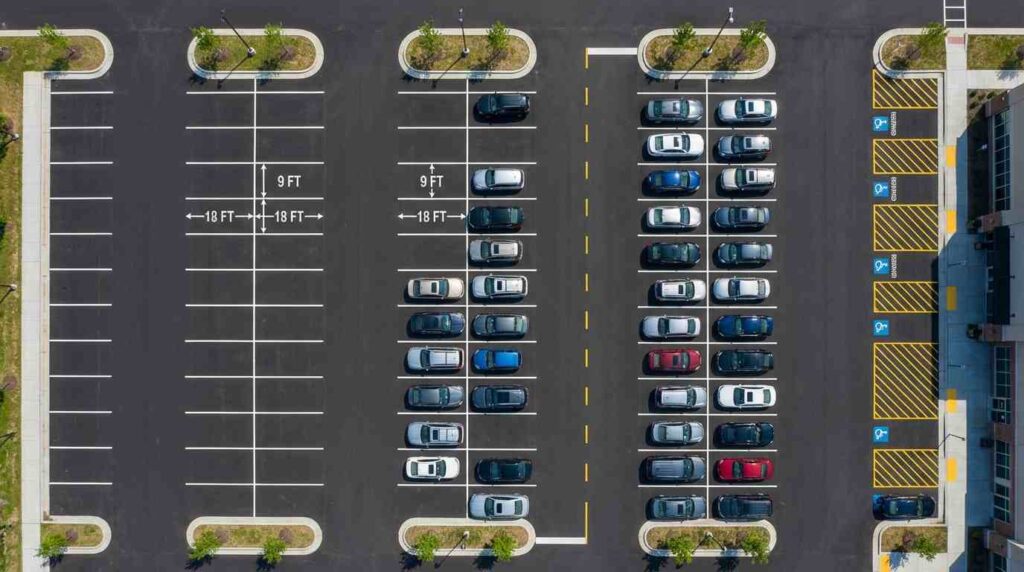
The distinction between compact and standard parking spaces allows facility managers to maximize capacity while accommodating different vehicle sizes. Compact parking spaces in the United States typically measure 8 feet by 16 feet, compared to the standard 9 feet by 18 feet. These smaller spaces are suitable for sedans, hatchbacks, and other compact vehicles, but should be clearly marked to prevent larger vehicles from attempting to use them. Standard spaces accommodate the full range of passenger vehicles including mid-size sedans, crossovers, and smaller SUVs.
Parking facilities typically designate 20-30% of spaces as compact to balance space efficiency with user convenience. The decision to implement compact spaces depends on the expected vehicle mix, with urban locations serving more compact cars benefiting from higher compact space ratios.
| Space Type | Width (US) | Length (US) | Width (Metric) | Length (Metric) | Suitable Vehicles |
|---|---|---|---|---|---|
| Compact | 8 ft | 16 ft | 2.4 m | 4.9 m | Sedans, hatchbacks, small cars |
| Standard | 9 ft | 18 ft | 2.7 m | 5.5 m | Most passenger vehicles |
| Mid-Size | 9.5 ft | 19 ft | 2.9 m | 5.8 m | SUVs, larger sedans |
| Large/Oversized | 10-12 ft | 20-24 ft | 3.0-3.7 m | 6.1-7.3 m | Trucks, large SUVs |
| Van/Commercial | 11 ft | 22 ft | 3.4 m | 6.7 m | Cargo vans, work vehicles |
Parallel Parking Dimensions
Parallel parking requires different dimensional considerations than perpendicular or angled parking due to the linear arrangement along roadways. Standard parallel parking spaces in the United States typically measure 8 feet 6 inches by 23 feet, with the 23-foot length including 19 feet for the parking spot itself and 4 feet of safety space. The minimum parallel parking dimensions are 22 feet long and 8.5 feet wide for street parking applications. Additionally, at least 12 feet of space should be provided adjacent to the parallel spot to ensure adequate room for traffic flow.
Parallel parking is commonly used for on-street parking in urban environments and along commercial corridors where perpendicular parking would impede traffic flow. The longer length requirement accommodates the turning movements required for vehicles to enter and exit the space.
| Parallel Parking Type | Width | Length | Adjacent Clearance | Application |
|---|---|---|---|---|
| Standard Parallel | 8.5 ft | 22 ft | 12 ft | Street parking |
| Standard with Safety | 8.5 ft | 23 ft (19+4) | 12 ft | Commercial streets |
| Large Vehicle Parallel | 9 ft | 24 ft | 12 ft | Truck zones |
| Motorcycle Parallel | 4 ft | 8 ft | 10 ft | Two-wheeler zones |
| Bus Loading Zone | 12 ft | 40-60 ft | 12 ft | Transit stops |
ADA Accessible Parking
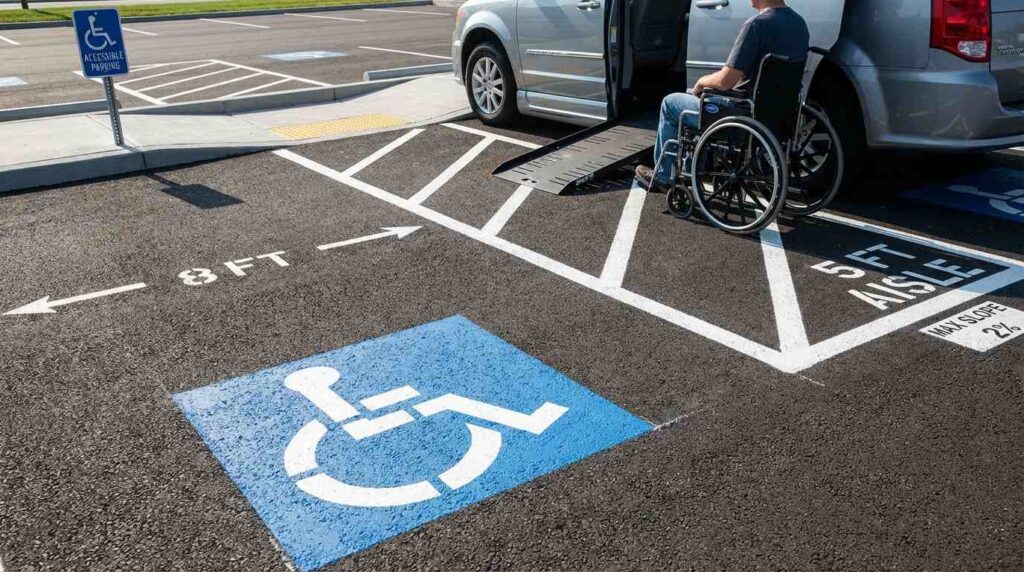
The Americans with Disabilities Act (ADA) establishes specific requirements for accessible parking spaces to ensure equal access for people with disabilities. ADA-compliant parking spaces must measure 8 feet wide with an adjacent 5-foot access aisle, totaling 13 feet of width, and 18 feet in length. Van-accessible spaces require either an 8-foot access aisle or a wider 11-foot parking space with a 5-foot aisle. The access aisle must be marked with diagonal stripes and remain clear of obstructions to allow wheelchair deployment and maneuvering.
Facilities must provide a minimum number of accessible spaces based on total parking capacity, typically ranging from one accessible space for facilities with 1-25 total spaces to 2% of total spaces for larger facilities. At least one space must be van-accessible for every six accessible spaces or fraction thereof.
| ADA Space Type | Parking Width | Aisle Width | Total Width | Length | Required Slope |
|---|---|---|---|---|---|
| Car Accessible | 8 ft | 5 ft | 13 ft | 18 ft | Max 1:48 (2.08%) |
| Van Accessible (Standard) | 8 ft | 8 ft | 16 ft | 18 ft | Max 1:48 (2.08%) |
| Van Accessible (Alt) | 11 ft | 5 ft | 16 ft | 18 ft | Max 1:48 (2.08%) |
| Access Aisle | N/A | 5 ft minimum | N/A | 18 ft | Max 1:48 (2.08%) |
| Van Access Aisle | N/A | 8 ft minimum | N/A | 18 ft | Max 1:48 (2.08%) |
Angled Parking Configurations
Angled parking provides an efficient alternative to perpendicular parking by facilitating easier vehicle maneuvering and reducing required aisle widths. 45-degree angled parking typically requires spaces 12-14 feet wide (measured perpendicular to the curb) by 20-22 feet deep, with aisle widths of 12-14 feet for one-way traffic. 60-degree parking requires 14-16 feet of width by 22-24 feet of depth, with 22-24 foot aisles. 75-degree parking needs 18-20 feet in width by 24-26 feet in depth, suitable for high-traffic areas.
Angled parking is particularly effective in retail centers and office complexes where traffic flows primarily in one direction. The shallower angles (30-45 degrees) maximize the number of spaces along a given length of curb while maintaining easy entry and exit.
| Parking Angle | Space Width | Space Depth | Aisle Width | Best Application |
|---|---|---|---|---|
| 30° | 10-12 ft | 18-20 ft | 12-14 ft | Limited-space areas |
| 45° | 12-14 ft | 20-22 ft | 12-14 ft | Retail centers, one-way flow |
| 60° | 14-16 ft | 22-24 ft | 14-16 ft | Office complexes, medium traffic |
| 75° | 18-20 ft | 24-26 ft | 18-20 ft | High-traffic commercial areas |
| 90° (Perpendicular) | 9 ft | 18 ft | 24-26 ft | Maximum capacity, two-way |
Planning and Design Considerations
Effective parking lot design requires careful consideration of multiple factors beyond individual space dimensions. The minimum parking lot drive aisle width for two-way traffic should never be less than 24 feet, especially in commercial or ADA-accessible facilities. One-way aisles can be narrower, typically 12-16 feet depending on parking angle. Turning radii at intersections and entry points must accommodate the largest expected vehicle, usually requiring minimum 20-foot inside radii for passenger cars and 40 feet for delivery trucks.
Proper drainage, lighting, signage, and pavement markings are essential for safe and functional parking facilities. Facility managers should allocate 2-3 feet of clearance beyond minimum dimensions whenever possible to improve user experience and reduce vehicle damage. Modern 2026 parking design increasingly incorporates EV charging stations, which may require slightly wider spaces (10 feet) to accommodate charging equipment and cables.
| Design Element | Minimum Requirement | Recommended | Purpose |
|---|---|---|---|
| Two-Way Aisle | 24 ft | 26 ft | Traffic circulation |
| One-Way Aisle (90°) | 12 ft | 14 ft | Access to perpendicular spaces |
| One-Way Aisle (45-60°) | 12-14 ft | 14-16 ft | Angled parking access |
| End Bay Clearance | 1 ft | 2 ft | Overhang protection |
| Column/Wall Clearance | 1 ft | 2 ft | Door opening space |
| Turning Radius (Cars) | 20 ft inside | 25 ft inside | Maneuvering |
| Turning Radius (Trucks) | 40 ft inside | 45 ft inside | Delivery access |
| EV Charging Space | 10 ft | 10-11 ft | Equipment clearance |
| Lighting Level | 1-3 foot-candles | 5-10 foot-candles | Safety and security |
International Comparison Summary
Comparing parking standards across countries reveals significant variations driven by vehicle sizes, urban density, and regulatory philosophies. The United States implements the most generous dimensions at 9×18 feet, reflecting the prevalence of larger vehicles and ample land availability. European and Asian countries generally favor more compact dimensions ranging from 7.5-8.2 feet wide by 15.7-16.4 feet long, maximizing space efficiency in denser urban environments. The United Kingdom and France represent the smallest standard dimensions at approximately 7.5-8 feet wide, suited to their compact vehicle fleets.
Australia and New Zealand fall in the middle range at 8.2 feet wide by 16.4-17.7 feet long, balancing space efficiency with user convenience. When planning international developments or accommodating tourists, designers should consider the larger dimensions to ensure accessibility for all vehicle types.
| Country/Region | Width (Feet) | Length (Feet) | Width (Meters) | Length (Meters) | Space Philosophy |
|---|---|---|---|---|---|
| United States | 9-10 | 18-20 | 2.7-3.0 | 5.5-6.1 | Generous, vehicle-centric |
| Canada | 8.5-9 | 18 | 2.6-2.7 | 5.5 | Similar to USA |
| United Kingdom | 7.9 | 15.7-16 | 2.4 | 4.8 | Compact, space-efficient |
| France | 7.2-7.5 | 16.4 | 2.2-2.3 | 5.0 | Very compact |
| Germany | 7.9-11.5 | 16.4 | 2.4-3.5 | 5.0 | Regulated, accessibility-focused |
| India | 8.2 | 16.4 | 2.5 | 5.0 | Moderate, traffic-based |
| Japan | 7.5-8.2 | 16.4 | 2.3-2.5 | 5.0 | Very compact |
| China | 8.2 | 18 | 2.5 | 5.5 | Moderate, growing vehicles |
| Australia | 7.9-8.2 | 16.4-17.7 | 2.4-2.5 | 5.0-5.4 | Regulated, balanced |
| UAE | 8.2-11.5 | 16.4 | 2.5-3.5 | 5.0 | Category-based |
Q1: What is the standard parking space size in the United States?
A1: The standard parking space size in the United States is 9 feet wide by 18 feet long. Some regions allow smaller dimensions of 8 feet wide by 16 feet long for compact spaces, while larger spaces of 10-12 feet by 20-24 feet accommodate trucks and oversized vehicles.
Q2: How do parking space dimensions differ between countries?
A2: Parking space dimensions vary significantly worldwide. The USA uses the largest standard at 9×18 feet, while the UK requires minimum 7.9×15.7 feet, India mandates 8.2×16.4 feet, and European countries range from 7.2-8.2 feet wide. These differences reflect local vehicle sizes and urban density considerations.
Q3: What are ADA parking space requirements?
A3: ADA-compliant parking spaces must be 8 feet wide with an adjacent 5-foot access aisle, totaling 13 feet, and 18 feet long. Van-accessible spaces require either an 8-foot access aisle or an 11-foot parking space with a 5-foot aisle. The access aisle must have diagonal striping and maximum 2% slope.
Q4: What is the difference between compact and standard parking spaces?
A4: Compact parking spaces typically measure 8 feet by 16 feet, while standard spaces are 9 feet by 18 feet in the USA. Compact spaces accommodate sedans and small cars, saving approximately 20-25% space. Most facilities designate 20-30% of spaces as compact to balance capacity with user convenience.
Q5: How wide should parking lot aisles be?
A5: Two-way traffic aisles for perpendicular 90-degree parking should be minimum 24 feet wide, preferably 26 feet. One-way aisles can be 12-14 feet for perpendicular parking. Angled parking requires 12-18 feet for one-way traffic depending on angle. ADA-accessible facilities should never use less than 24 feet for two-way aisles.